Trauma is a fraught subject for writing and writers. Write it badly and we run the risk of trauma porn, creating stories that focus on harm for the sake of harm. Or we run the risk of stories that reduce everything to a single traumatic event, narratives that eschew complexity and complication, that fall into the trap of Parul Sehgal’s lamented trauma plot. There are also social and political considerations to writing about trauma. Whose stories are all about trauma? Whose stories get reduced to trauma points?
But trauma and harm are realities for many writers, myself included, and to avoid trauma as a subject can feel like an erasure. To write realistically about trauma, we may need to write stories that focus on its reductiveness, the way it can seem all consuming. Some of the most successful writing about trauma uses various hallmarks of traumatic experience—flashbacks, memory gaps, repetition, rumination—as narrative form. This class will explore how trauma features have been repurposed as formal experimentation by writers such as Gayl Jones, Maria Fernanda Ampuero, Monica Ojeda, and Marie-Helene Bertino. It will also contain a generative component and create nurturing space for participants to think about how formal experimentation might support their own writing about trauma.
Please note that this class will deal with serious and traumatic themes. No one affiliated with this writing class is a medical professional and advice and discussion is intended to be educational in nature.
August 26th from 6:30-8:30 pm
$95
15% discount for Backstory co-working and community members.
Sliding scale funds available – email hi@thebackstoryabove.com for more info.
Trauma is a fraught subject for writing and writers. Write it badly and we run the risk of trauma porn, creating stories that focus on harm for the sake of harm. Or we run the risk of stories that reduce everything to a single traumatic event, narratives that eschew complexity and complication, that fall into the trap of Parul Sehgal’s lamented trauma plot. There are also social and political considerations to writing about trauma. Whose stories are all about trauma? Whose stories get reduced to trauma points?
But trauma and harm are realities for many writers, myself included, and to avoid trauma as a subject can feel like an erasure. To write realistically about trauma, we may need to write stories that focus on its reductiveness, the way it can seem all consuming. Some of the most successful writing about trauma uses various hallmarks of traumatic experience—flashbacks, memory gaps, repetition, rumination—as narrative form. This class will explore how trauma features have been repurposed as formal experimentation by writers such as Gayl Jones, Maria Fernanda Ampuero, Monica Ojeda, and Marie-Helene Bertino. It will also contain a generative component and create nurturing space for participants to think about how formal experimentation might support their own writing about trauma.
Please note that this class will deal with serious and traumatic themes. No one affiliated with this writing class is a medical professional and advice and discussion is intended to be educational in nature.
August 26th from 6:30-8:30 pm
$95
15% discount for Backstory co-working and community members.
Sliding scale funds available – email hi@thebackstoryabove.com for more info.

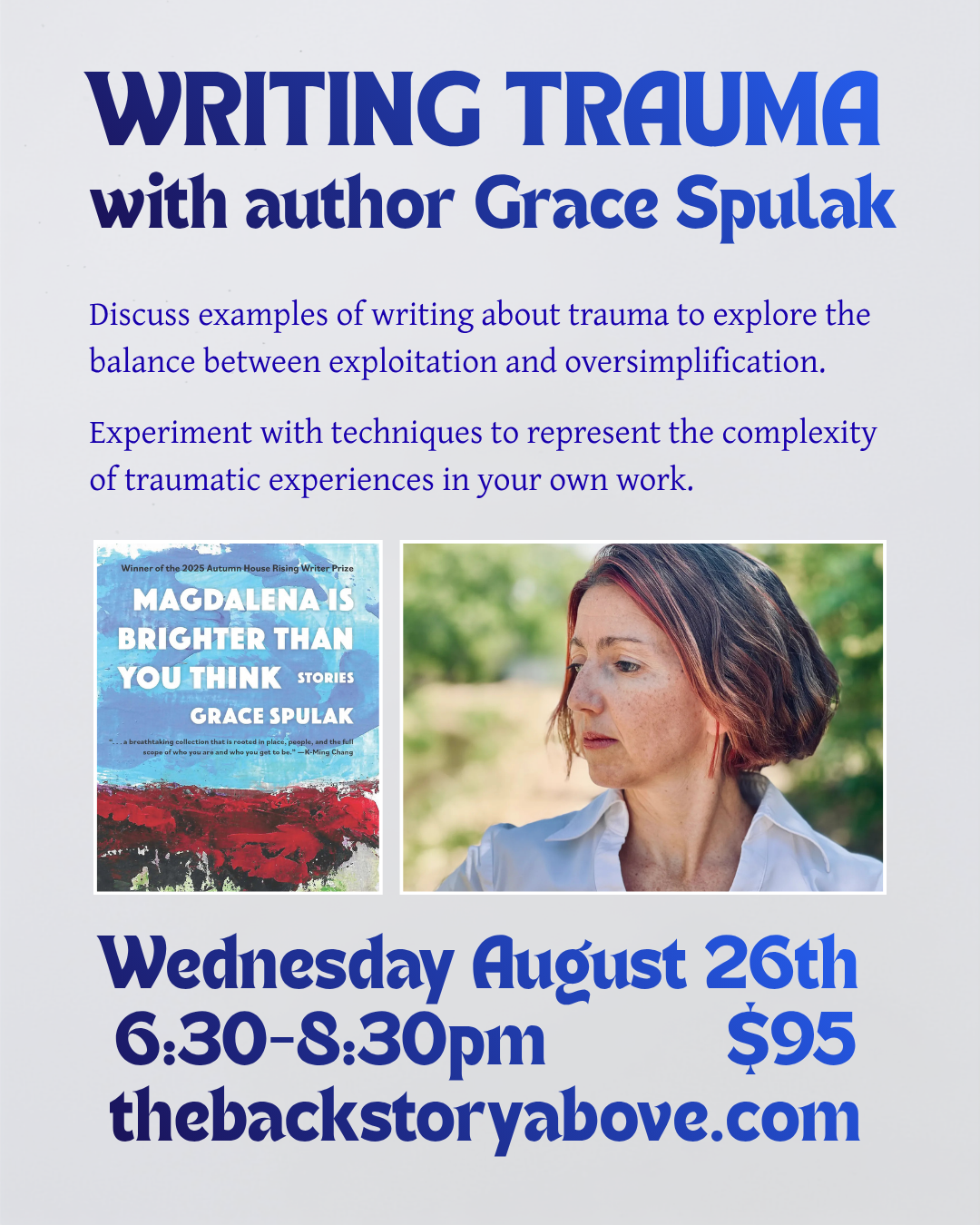 Image 1 of 1